

Pythagoras
Or the Oracle at Crotone

Deep in Southern Italy on the Ionian coast, the direction of the east, in the ancient Greek city Crotone/Kroton, in modern day Calabria, the Pythagorean “school of medicine” was founded in the 6th century BCE.
It was founded by the great Greek mystic Pythagoras who used rationality to bring the sacred into the material world. He, and his followers, joined them together into a third thing, a way of being in this world while still being in contact and communion with the divine. This was not something he made up.
“The Gods….are the higher intelligence that things possess when they are perceived in interrelation with one another. To say there are no gods is to say things do not have, in addition to their material constitution, the odor or glow of intellectual significance, of meaning. It is to say that life is senseless, that things are bereft of interconnections.”
-Jose Ortega y Gasset
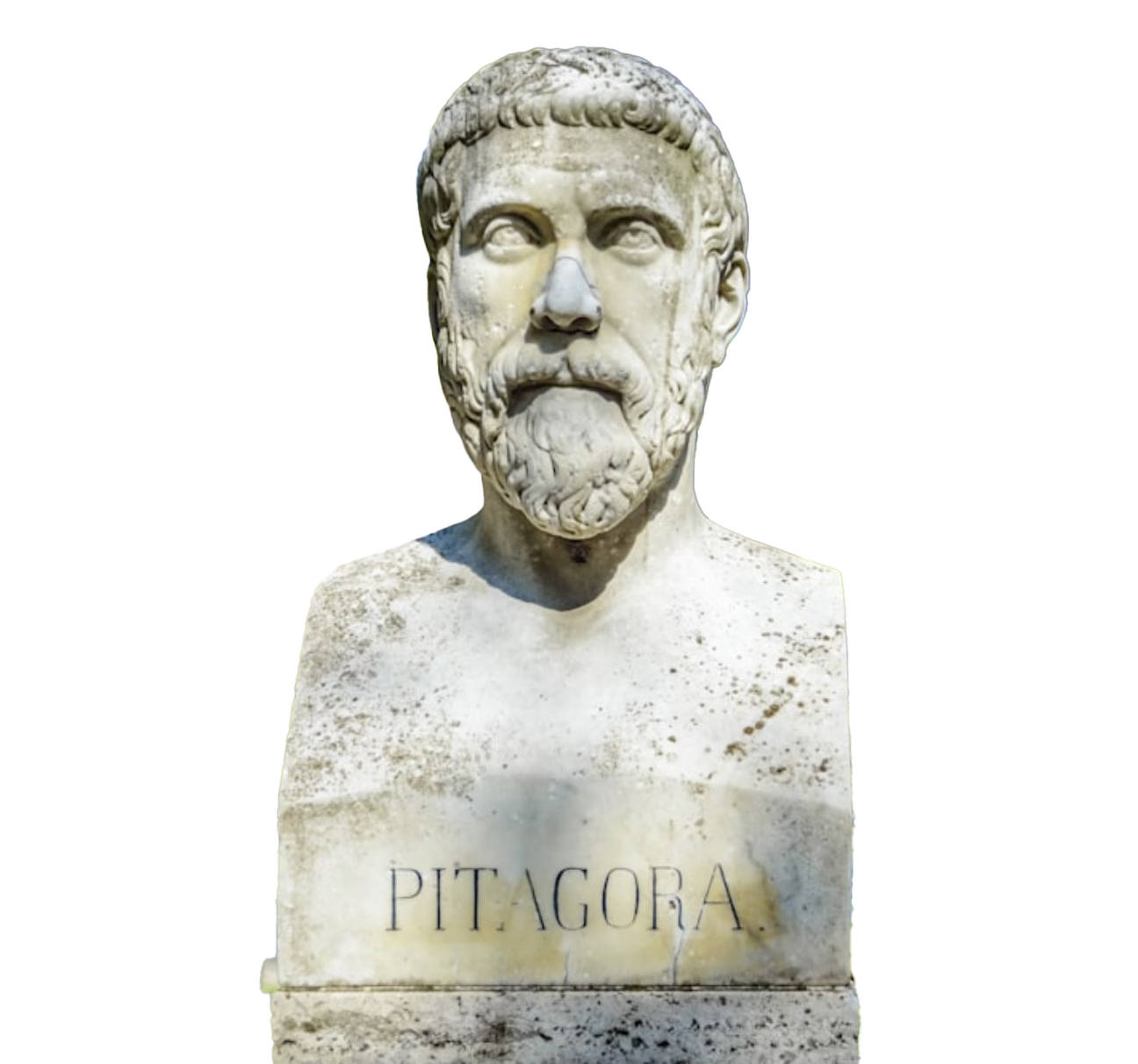
At this time in history the concept of medicine was not the same as it is today, although many of the thoughts, theories, and practices that emerged from this school became the foundation of today’s modern biomedicine as well as many of our mathematical theories.
The great mystic, mathematician, and philosopher Pythagoras settled in the ancient city of Kroton in about 530 BCE. This city was one of many Greek settlements in Magna Graecia (Great Greece) and what is now the city of Crotone in Calabria, Southern Italy.
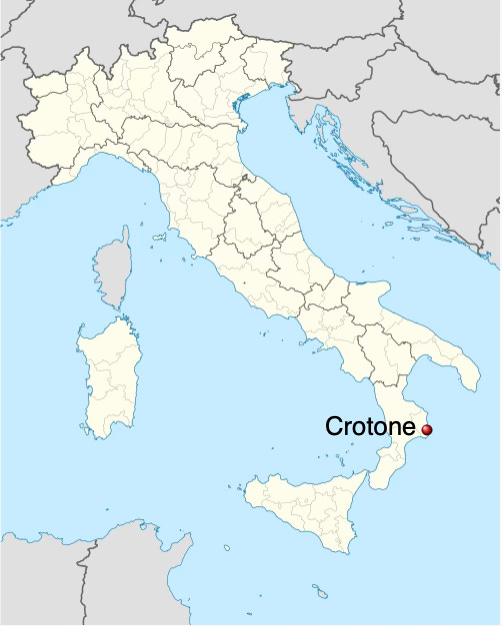
Crotone (once known as Kroton or Crotona) was originally a Greek colony founded around 710 BCE by the Achaeans from the northern regions of the Peloponnese, known as Achaea. Before Greek colonization Crotone was inhabited by the indigenous Oenotrians (the people of the vine) as well as many other groups throughout history and pre-history.
The founder of the Greek settlement was Myscellus from the city of Rhypes in Achaea who, according to Ancient Greek philosopher Diodorus from Sicily, was instructed by the Delphic oracle to found Kroton:
“Myscellus, too short of back, beloved art thou
Of him, even Apollo, who works afar,
And he will give thee children; yet this first
Is his command, Croton the great to found
Amidst fair fields.”
-Diodorus, Book 8, Chapter 17
Pythagoras himself was originally from the Greek Island of Samos. According to legend his father, Mnesarchus, was a gem merchant. His mother was Pythais, originally known as Parthenis, but changed her name after visiting the Pythia of Delphi who foretold Pythagoras’ parents of his coming birth. And, it is told, that Pythagoras was named such in honor of the Delphic oracle.
PYTHA-GORAS
Pythō-agórās
Πῡθᾰγόρᾱς
His name derives from Ancient Greek “Pūthagórās (Πῡθᾰγόρᾱς)”.
The first part being Πῡθ (Pȳth) is the root form of the word Πυθώ (Pythō) according to the most widely accepted by classical scholars.
Pytho- referring to the python at Delphi and also meaning “to rot” which could be literally in reference to the slain Python that decomposed in underground caves of the Delphic temple but ALSO referring to the chthonic quality of Delphi and the Delphic oracle (The Pythia), as well as to Apollo himself who was the deity worshipped at the sanctuary at Delphi.
There is also some speculation that Πυθώ derives from the PIE root *dhewb- or *dʰewb-ṓ, meaning “deep, hollow, cavernous, bottom” And the ending -ᾰγόρᾱς or -agórās meaning assembly/marketplace/public speaker. Together lending to the meaning “orator of the depths” or if we go with the Delphic reference “orator of Delphi” or “Orator of Apollo”.
One classical source of this particular interpretation comes from Ovid in Metamorphosis as described here by Celia Campbell in her article “(Poetic) Licence to Kill: Apollo, The Python, and Nicander’s Theriaca in Ovid, Metamorphoses 1”:
“E. N. Genovese, ‘Serpent Leitmotif in the Metamorphoses’, in C. Deroux (ed.), Studies in Latin Literature and Roman History III (Leuven, 1983), 152 and n. 29, notes the overarching symbolism of snakes in the Metamorphoses, especially bracketed by the Python and Aesculapius, but also mentions the possibility of seeing Pythagoras’ name as ‘Python-speaker’…”1
Some accounts have said that the name “Pythagoras” was one that was given to him later in life though there is no strong evidence for this claim.
Pythagoras and his legacy becomes known to most of us when we learn algebra in school and, of course, when we learn the Pythagorean theorem; a2 + b2 = c2.
Pythagoras and the Pythagorean school are attributed with having invented this theorem and other numerical and algebraic discoveries (though it’s likely that these discoveries were the culmination of many other discoveries that had been developed in many other places around the Mediterranean region and the Near East including ancient Babylon).
Nevertheless, Pythagoras was not just calculating numbers, he was using math as a sacred tool to understand, know, and interact with the divine and the universe.
I have written more in depth about Pythagoras and his association with the sacred mysteries HERE and HERE.
He is believed to have been, at least, an initiate of the mystery tradition of the Orphics, if not a contributor to the writing of such or a custodian and lineage carrier of the Orphic hymns.
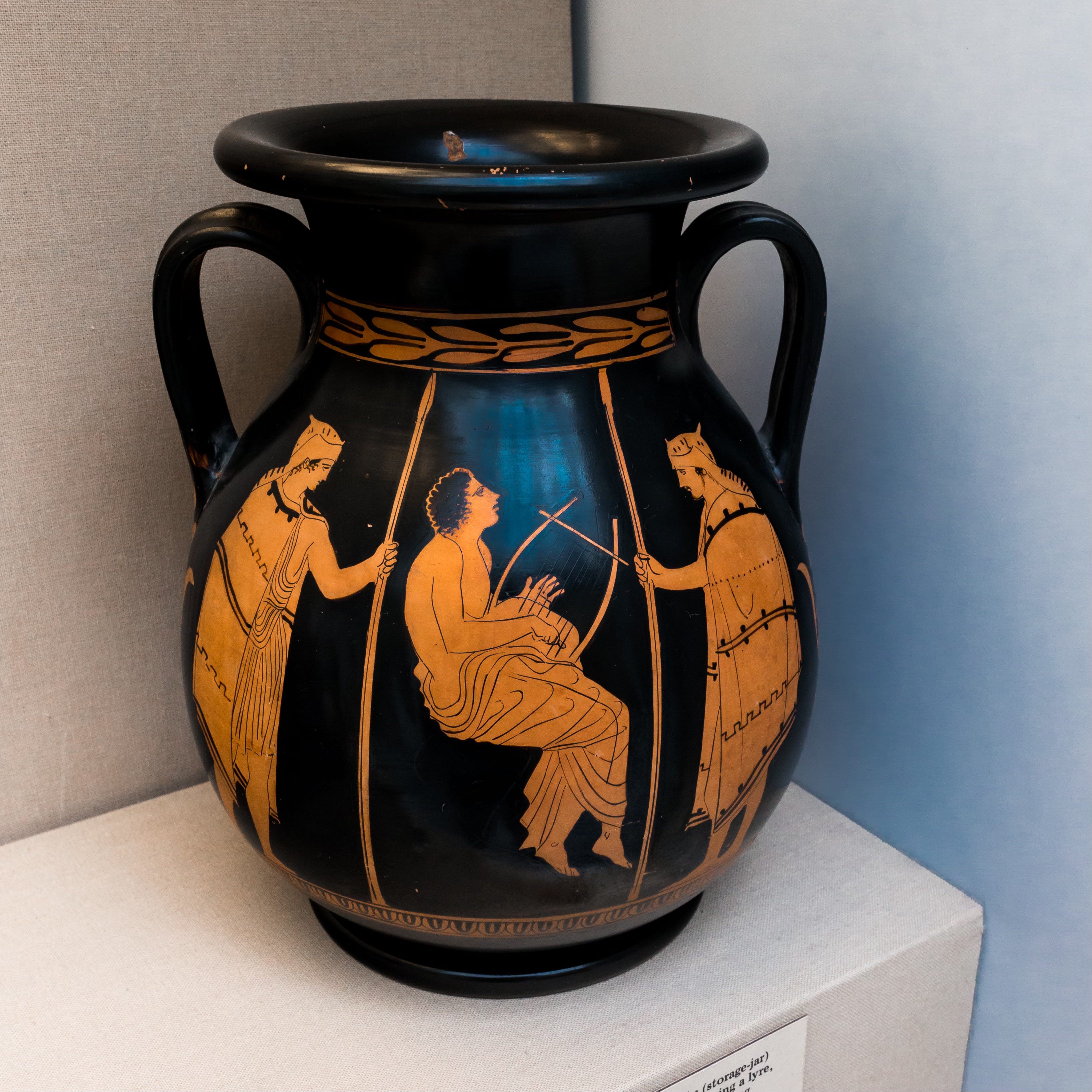
Orpheus and Pythagoras are both named in multiple ancient sources regarding the Orphic mysteries and other sacred spiritual practices of the Greek world.
“With the catchwords Orphic and Pythagorean, Orpheus and Pythagoras, Herodotus points to figures who, in contrast to the diffuse but always traditional Greek religion, assume for the first time the role of founders of sects, if not religions. The one appears in the guise of a singer and poet, the other in the guise of a philosopher. The most radical transformation of Greek religion is traced to these names.”
The mythical poet Orpheus, supposed author of the Orphic hymns which are part of the greater religious complex of Orphism, a shamanic mystery tradition, that originated in ancient Greece somewhere around the 7th-6th centuries BCE.
Though the ultimate origin of Orphism is complex, it is most generally believed to have originated in communities in the Black Sea region of Thrace where Orpheus is said to have been born. Its spread likely followed Amber trade routes to other regions. Another, less supported, theory is that it emerged from Magna Graecia (now Southern Italy and Sicily) or that there was at least some cultural symbiosis between both places.
The connection between the origin or Orphism and Southern Italy is partly based on the numerous amount of Orphic inscribed tablets found there along with other Orphic artifacts such as lyres and terracotta altars.
“One of the main reasons for this is the presence of the most direct type of evidence for the practice of Orphism, namely the large number of inscribed tablets. he tablets are found in numerous burials all over the Mediterranean world, but are particularly numerous in southern Italy (Pugliese Carratelli 1993).”2
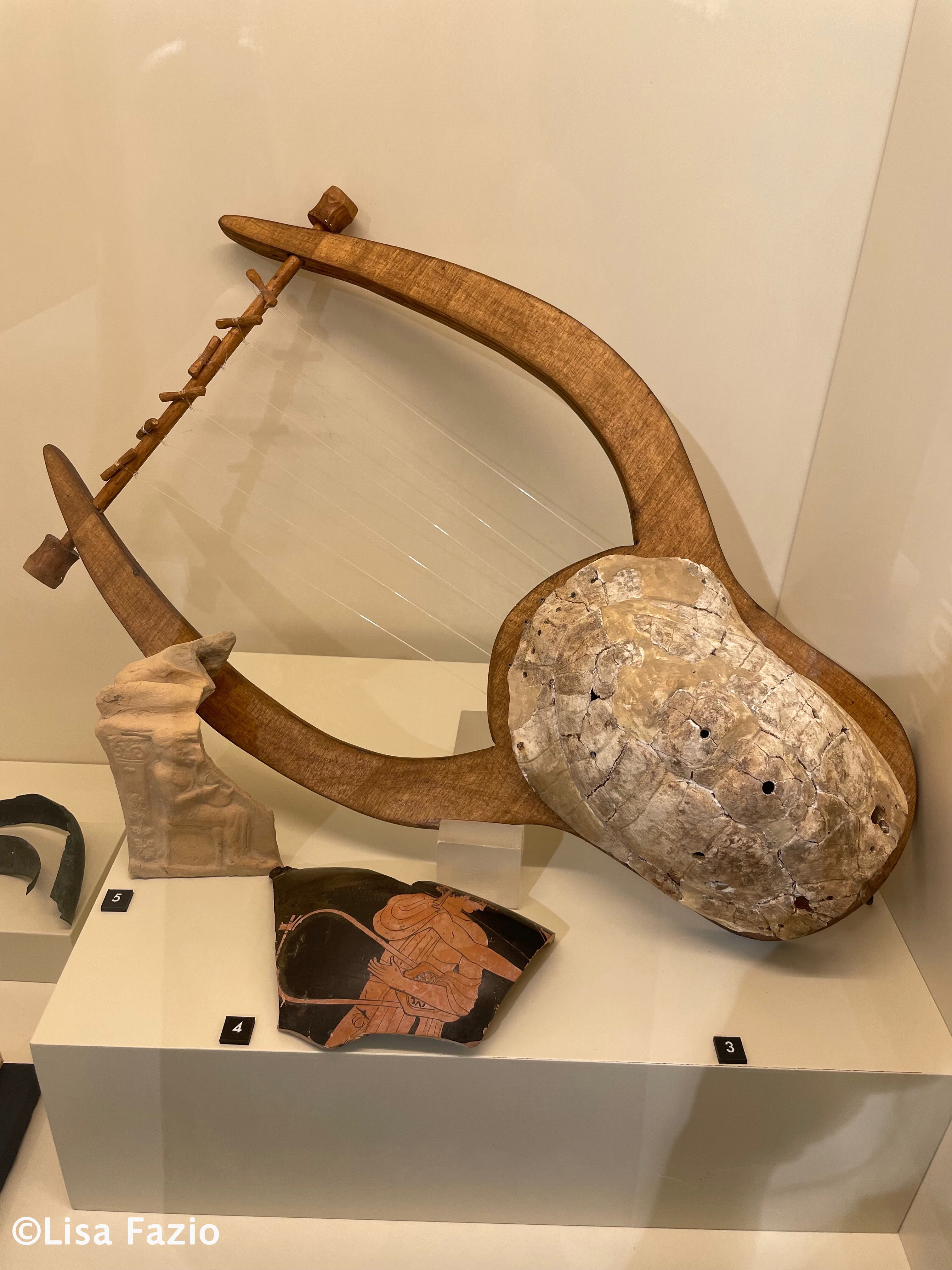
One thing is certain, and that is that the Orphic mysteries and developed strong roots in Southern Italy and Sicily and the way that we understand these mysteries today was highly influenced by the cultural contributions of Magna Graecia and it’s schools such as the one founded by Pythagoras.
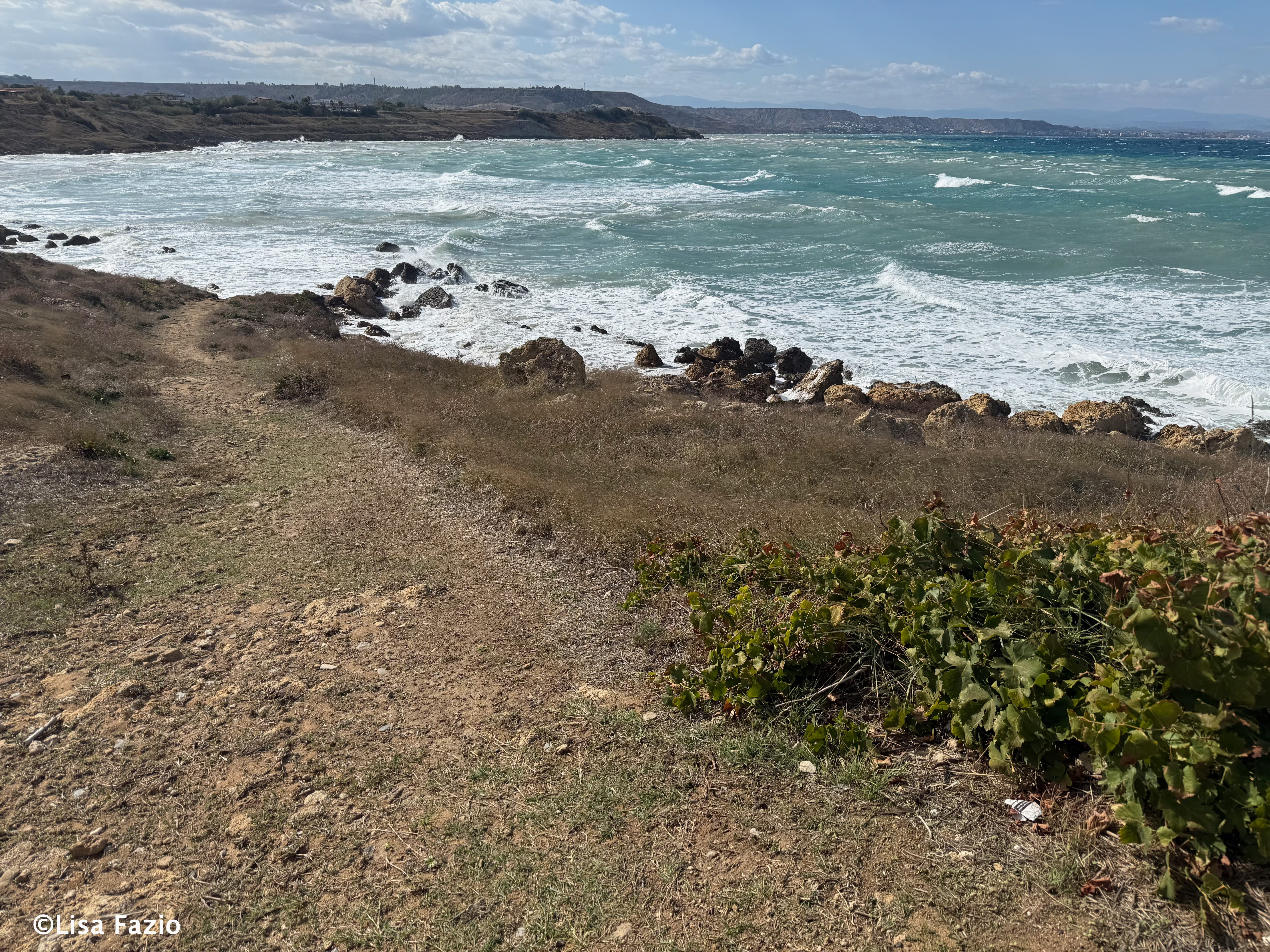
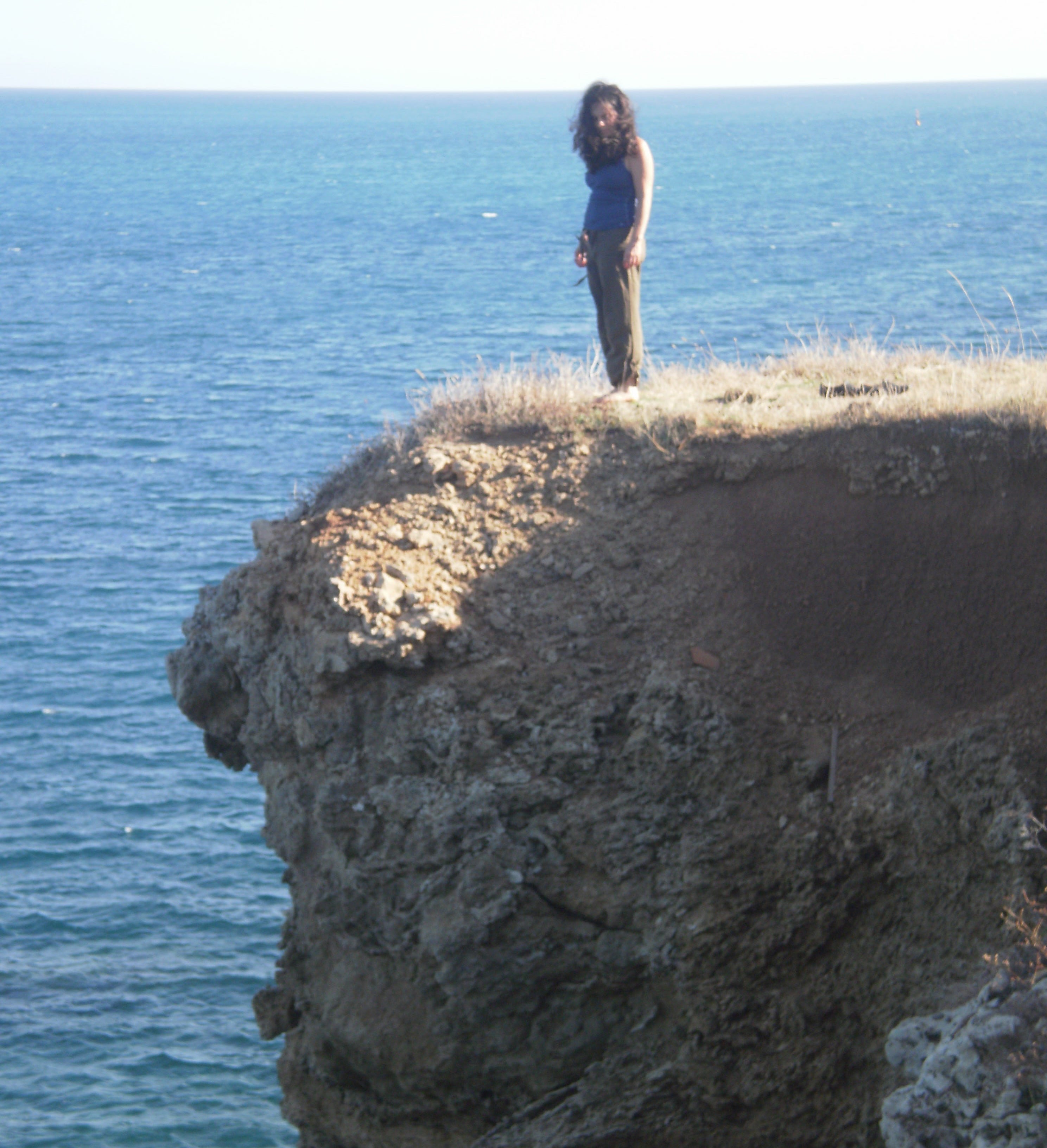
I recently visited Crotone, for the second time, and the “Gardens and Museum of Pythagoras” that is tended and curated by the modern city. I also made a second visit to promontory of Capo Colonna which is where the ruins of the Greek temple to Hera Lacinia remains along side what’s left of a Roman outpost and what is one of the oldest churches in Crotone, the shrine to the Madonna of Capo Colonna.
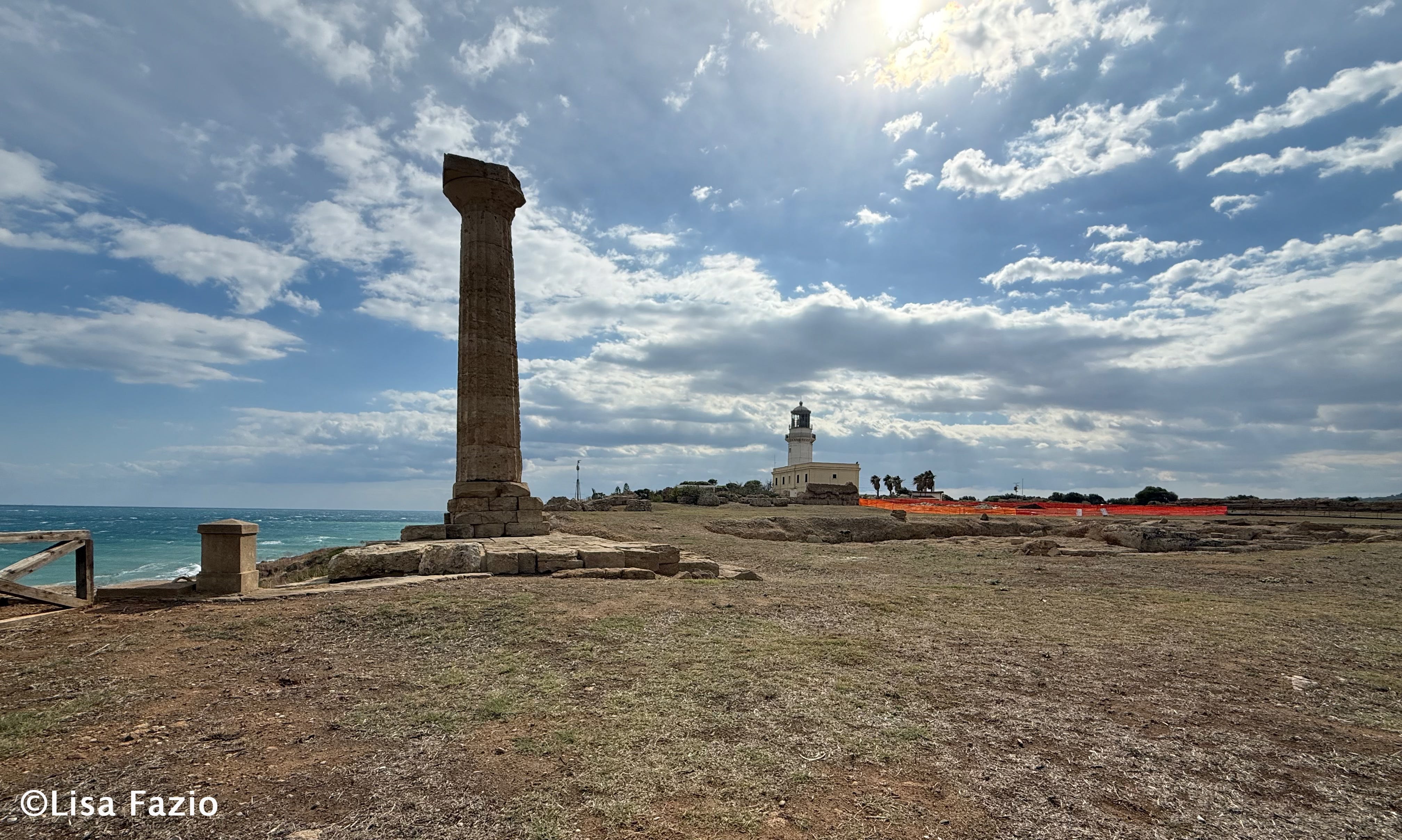
Our traditional cultures from antiquity show us the difference between applying our innovations toward more communion with the forces of the unseen and using them to ignore them. Pythagoras and many other philosophers from the Mediterranean and around the world encountered and adapted techniques such as mathematics as modes of divination, modes of divining the will of the “gods” so that they could learn the way these powers dwell within the material world and how they can be attuned to in a way that creates unity and healing.
“Those who have no belief in a life beyond this one cling with terror to this life, even while despising it at times; they eagerly justify every miraculous invention of the modern day, regardless of its negative impact on humanity and this world. If there were such a thing as an ‘untrance’- a reversal of trance, a reversal of the passage between two states, and a solidification into a state of constant focus on the material and the passionless, stale fear of existing, these modernists can be said to have mastered it. Their sorcery is the sorcery of despair and shallowness, and (as we have seen) it is a potent sorcery, indeed for now it, more than any other sorcery, command the fate of the world. Or so it would appear.”
-Robin Artisson from “Letters from the Devil’s Forest”

Another method the ancient used, at Crotone and in locations all over Italy and Greece, to achieve communion was “Dream Incubation”. The “schools” for physicians and philosophers included healing centers where divination and healing rituals were conducted by the priests and priestess another initiates of the mysteries.
Myself and Hellenic Dream Incubation practitioner Dafni Mangalousi are teaching together about this practice starting in January! See Below!
Dream Incubation Online Course
Is now open for early bird registration! (Until December 1)
Together we will be sharing about the practices of dream incubation, modern dreamwork, and plants and folk medicine for dreaming.
For full details, topics, and how the course will be formatted to include teaching, workshops, and dream share circles go HERE
Campbell, Celia. “(Poetic) Licence to Kill: Apollo, the Python, and Nicander’s Theriaca in Ovid, Metamorphoses 1.” Greece & Rome, Second Series, vol. 65, no. 2, 2018, pp. 155–174.
Petersen, Jane Hjarl. “Constructing Identities in Multicultural Milieux: The Formation of Orphism in the Black Sea Region and Southern Italy in the Late 6th and Early 5th Centuries BC.” Communicating Identity in Italic Iron Age Communities, edited by Margarita Gleba and Helle W. Horsnæs, Oxbow Books, 2011.